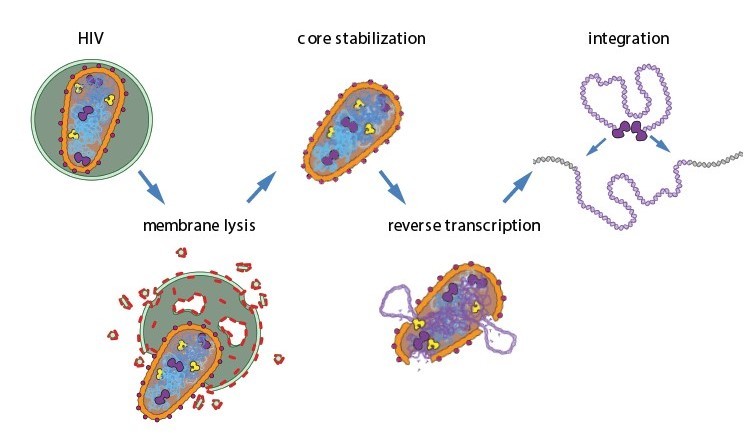
Tuesday, October 20, 2020 Illustration summarizing the steps researchers took to make HIV reverse transcription and integration happen in a test tube. Credit: Janet Iwasa and Devin Christensen, University of Utah Health The conditions under which HIV reverse transcription and integration occur have been under debate for many years. Central to that debate has been the role of the cone-shaped "capsid" nestled inside the spherical membrane that encloses the virus. In new NIAID-supported research, the first test-tube system where early events in HIV replication take place clarifies that reverse transcription must happen inside a largely intact capsid. Removing the capsid from the test tube and adding soluble material from human cells enabled a complete copy of HIV DNA to fully integrate into circular DNA. These findings are published in the journal Science.  | 





No comments:
Post a Comment