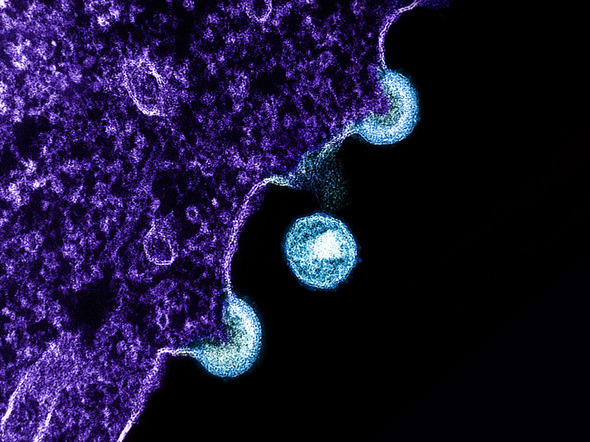
| Thursday, January 18, 2024 Transmission electron micrograph of HIV-1 virus particles (blue) from infected H9 cells, produced in cell culture. The particles exhibit two stages of replication: the two "arcs" are immature particles budding from the plasma membrane of the cell, and the center spherical particle is a mature form in extracellular space. Image captured at the NIAID Integrated Research Facility in Fort Detrick, Maryland. Credit: NIAID Three different HIV antibodies isolated by the NIAID Vaccine Research Center each independently protected monkeys from acquiring simian-HIV (SHIV) in a study intended to inform development of a preventive HIV vaccine for people. The antibodies target the fusion peptide, a site on an HIV surface protein that helps the virus fuse with and enter cells. According to the authors, these findings represent the proof-of-concept that fusion peptide-directed antibodies can provide protection against SHIV and help determine the concentration of antibodies a vaccine would need to generate to be protective. The findings are published in Science Translational Medicine.  | 




No comments:
Post a Comment